
One night in June 2015, a man left Facebook’s rambling innovation grounds in Menlo Park, California with two infant blue bikes. They were a piece of a common armada offered as a corporate advantage; workers should ride them off the property, yet many overlook this standard, surrendering them around town to the rage of Facebook’s neighbors.
That night, Facebook’s security watches announced the bikes as taken. Also, subsequent to pinging their directions on GPS trackers, they cautioned the Menlo Park Police Department, saying the organization proposed to indict. A cop immediately found a Hispanic man and captured him for theft.
It’s normal for occupants to entrepreneurially utilize Facebook’s disposed of bikes, and for quite a long time police routinely halted individuals—remarkably youngsters of shading, as indicated by some network accounts—for riding them, inciting fears about racial profiling. The bikes turned into a startling image of police strain in Menlo Park and East Palo Alto, where minorities feel condemned under the shadow of gigantic innovation riches.
The 2015 occurrence, which Facebook prevents any information from claiming, is remarkable due to what occurred after the capture: Nothing. The man, it turned out, was a Facebook provisional laborer. As per Menlo Park police reports that Motherboard acquired through an open records demand, “when delegates from Facebook discovered that [the man] was a Facebook worker they mentioned that no criminal accusations be brought against him,” and he was discharged. The obedient consistence of the police—first pursuing Facebook property that Facebook workers left around the network as litter, at that point remaining down when told by Facebook that the offender was a piece of an exceptional, secured class—is a minor launch of a more extensive issue: Just how entwined Facebook and nearby police have become.
The Bay Area has for some time been a sandbox for innovation mammoths who are never again simply possessing networks, yet assembling and reshaping them. In Menlo Park, a well-to-do, for the most part white city of 35,000, Facebook at one point paid laborers not to live in lower-salary neighborhoods close to the organization’s home office. What’s more, presently, there’s a police unit that is financed by Facebook to watch the zone encompassing its grounds. The bill comes in at over $2 million every year—large cash in a little city.
This profoundly abnormal relationship has featured issues of policing morals and tossed inconsistencies between Menlo Park and neighboring East Palo Alto into unmistakable alleviation. When Menlo Park police started going up against individuals for riding Facebook bikes off-grounds, for example, inhabitants of East Palo Alto, a principally Black and Latinx people group, stressed that law implementation was racially profiling individuals who didn’t appear to them as Facebook workers.
“You make a risk when you have local officials being secretly subsidized,” J.T. Faraji, an East Palo Alto occupant and author of the dissident gathering Real Community Coalition, told Motherboard. “It turns into the privatization of the law, and the law should work for everybody. To me, that is a significant breakdown in the framework. It ought to be illicit for private partnerships to have their very own police power.”
(“Our financing isn’t a privatization of the law,” Facebook representative Anthony Harrison told Motherboard. “We have a long haul responsibility to Menlo Park, and we need it to stay a protected and comprehensive condition for everybody who calls it home.”)
The “Facebook Unit,” as it was nicknamed by Menlo Park police, has not gotten a lot of consideration outside of these networks, regardless of being one of the country’s just secretly supported open police powers.
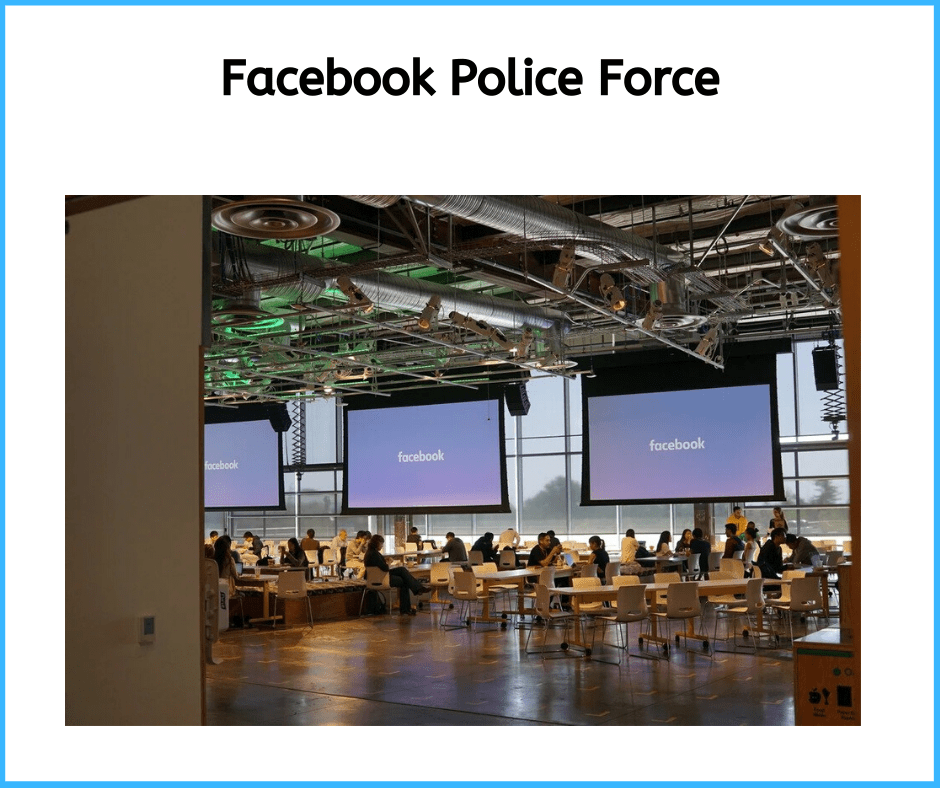
Open records got by Motherboard—many pages of notes, proposition in draft and last structure, introductions, and messages among Facebook and the Menlo Park Police Department more than quite a long while—give a remarkable take a gander at how the organization was produced and how it works, just as at open worries about law implementation’s personal connections to one of the most dominant innovation organizations on the planet.
“This would concern me as a network part,” said Chris Burbank of the Center for Policing Equity, an exploration consortium established at the University of California-Los Angeles that spotlights on straightforwardness in law authorization. “I couldn’t care less what it’s identity is. You don’t get the opportunity to purchase a police division.”
Facebook in Menlo Park
Eight years prior, Facebook exceeded its Palo Alto home office and moved to 1 Hacker Way, an eastern fragment of Menlo Park that previously housed the website sweetheart Sun Microsystems. There was open theory at the time about “whether Facebook’s generally youthful workforce will grasp a genuinely segregated grounds encompassed by one of Menlo Park’s increasingly disturbed neighborhoods.” But in obvious majestic style Facebook then spread west, spending more than $1 billion on a Frank Gehry-planned grounds overflowing with comforts, for example, spring up shops, bicycle ways, redwood forests, and “green-scapes.”
Its most recent success is a corporate complex called Willow Village only south of 1 Hacker Way. When complete, it will end up being the biggest improvement in Menlo Park’s history, with 1.75 million square feet of workplaces, up to 200,000 square feet of retail, 1,500 lodging units, stops, an inn, eateries, and conceivably even a town square.
As Facebook grabbed up land, it guaranteed a suite of open restitutions being developed understandings hit with the city. The organization announced in distinctively vainglorious terms that its vision for Menlo Park would be one “that advances association and network.” (Critics compared the territory to an “organization town.”)
Furthermore, in 2013, Facebook paid to balance a police substation in Menlo Park’s most unfortunate neighborhood, Belle Haven, which is adjoining Facebook’s grounds and home to a considerable lot of the city’s Latinx occupants. After one year, the organization gave Menlo Park a $600,000 award to procure a network wellbeing official for the substation for as long as five years. This was then accepted to be the country’s just secretly subsidized full-time policing work.
The nontraditional association of open and private interests was secured by outlets, for example, the New York Times, which composed that the arrangement “evoked some anxiety.” But little justification has been given for why Facebook is approved to do this, and what its inspirations are.
Together, Facebook and Menlo Park’s administration swatted down grievances from residents, journalists, and guard dog bunches that the association is disturbing, considerably evil. They wanted to introduce the game plan as an “open advantage,” and the best, most obvious end result to a corporate behemoth changing a urban scene. In light of worries about particular treatment, the Menlo Park Police Department disclosed to NBC Bay Area in 2015 that only .02 percent of administration calls that year were to Facebook central command.
However meetings and records got by Motherboard advise an alternate truth. Something other than being neighborly, Facebook is planning and building a biological system in its own picture.
The beginning of the “Facebook Unit”
Around 2016, Facebook moved toward the Menlo Park Police Department about financing another unit—involved five officials and one sergeant—to cover the zone incorporating its present and future grounds. The zone was given the moniker “M-2” and sits kitty-corner to East Palo Alto, and would in the end become a fourth police watch called “Beat 4.”
On February 4, 2016, Dave Bertini, who is currently Menlo Park’s police boss yet filled in as leader at the time, messaged then-police boss Robert Jonsen with a proposition for the Facebook Unit.
“Facebook Inc. has moved toward the Police Department in regards to appointing a particular group of cops to the Facebook grounds,” it stated, alluding to face to face talks among Facebook and police.
Roughly 14,674 of Facebook’s representatives work in Menlo Park, and Willow Village would expand that ability to 35,000. This introduced a strategic worry for the Menlo Park Police Department, which keeps up a proportion of 1 official to 1,000 individuals in the city during the daytime. At a certain point, Facebook “proposed contracting on furlough officials from different networks” to address this issue, as per police records.
By city evaluates, the office would require another 17 sworn officials by 2040 to keep up business as usual. “Facebook stated, ‘How about we give you a kick off,'” Bertini told Motherboard. “It was their method for saying, ‘Let us assist you with relieving the effect of us being here.'”
“We have to show how the 1 official to 1000 adjusted populace will be extended without our underlying help,” Facebook’s executive of worldwide security administrations, Marjorie Jackson, wrote in a strategizing email to Jonsen on March 1, 2017.
In any case, records show that policing proportions were just piece of the push to make the new unit.
“In the wake of ongoing prominent fear monger or psychological militant propelled assaults […] Facebook and the police office know about the uplifted requirement for security for the Facebook grounds and its representatives and guests,” the police proposition expressed. “At issue is the police work force important to react to such occurrences alongside a present absence of any deterrence…at the Facebook grounds.”
(A later form of this proposition swapped “fear based oppressor or psychological oppressor propelled assaults” for “dangers against interests in this nation.”)
Bertini disclosed to Motherboard he has “almost certainly” that Facebook is an objective. “It is anything but a matter of in case we will have an outfitted gatecrasher, it’s simply a question of when,” he said.
Bertini was among the individuals who reacted to the 2018 taking shots at YouTube’s San Bruno grounds where a lady harmed three individuals before biting the dust by suicide. Following the episode, he told the San Mateo Daily Journal that he expanded foot watches at Facebook and wanted to.
 Latest Technology