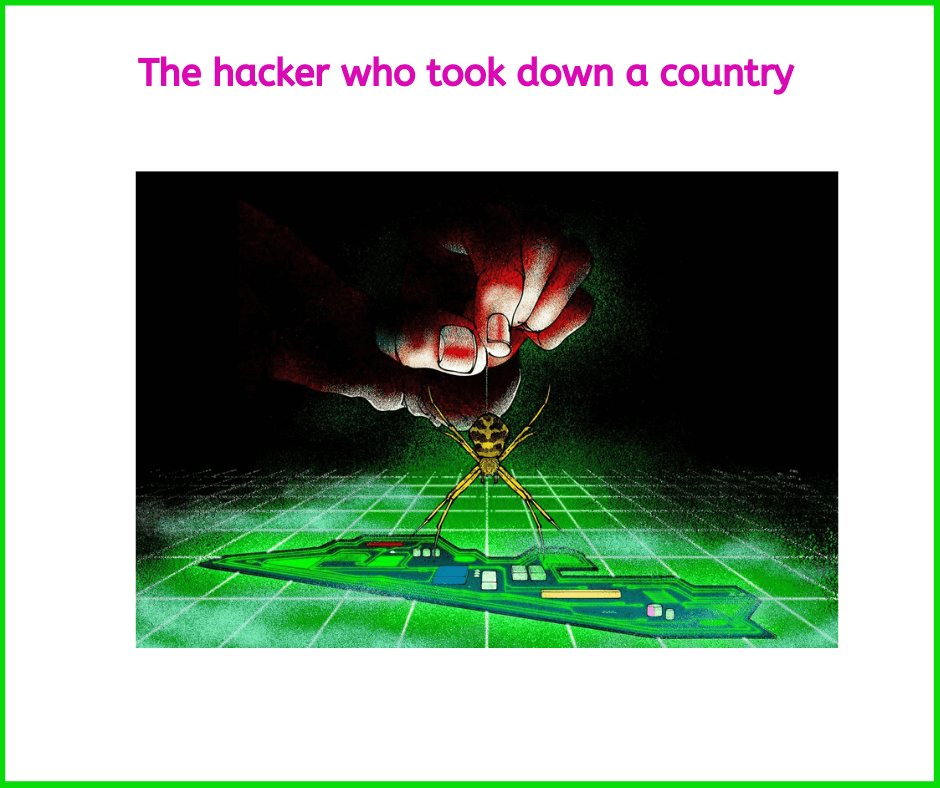
The assault against Liberia started in October 2016. In excess of a half-million surveillance cameras around the globe attempted to associate with a bunch of servers utilized by Lonestar Cell MTN, a neighborhood cell phone administrator, and Lonestar’s system was overpowered. Web access for its 1.5 million clients eased back to slither, at that point halted.
The specialized term for this kind of attack is dispersed refusal of administration, or DDoS. Unrefined however successful, a DDoS assault utilizes a multitude of held machines, called a botnet, to at the same time associate with a solitary point on the web. This botnet, however, was the greatest at any point saw anyplace, let alone in Liberia, perhaps the least fortunate nation in Africa. The outcome was like what might occur if 500,000 additional vehicles joined the New Jersey Turnpike one morning at heavy traffic. While most DDoS assaults last just minutes, the ambush on Lonestar delayed for quite a long time. Furthermore, since Liberia has had for all intents and purposes no landlines since the ruthless common war that finished in 2003, that implied a large portion of the nation was cut off from bank exchanges, ranchers couldn’t check crop costs, and understudies couldn’t Google anything. In the capital of Monrovia, the biggest medical clinic went disconnected for about seven days. Irresistible malady authorities managing the consequence of a dangerous Ebola episode lost contact with global wellbeing organizations.
Eugene Nagbe, Liberia’s priest for data, was in Paris on business when the emergency started. He battled to marshal a reaction, unfit to get to his email or a solid telephone association. At that point his bank card quit working. On Nov. 8, with a huge number of individuals still detached, Nagbe went on French radio to claim for help. “The size of the assault discloses to us this involves grave concern, to Liberia as well as to the worldwide network that is associated with the web,” he said. The surge proceeded. Nobody appeared to know why, however there was hypothesis that the hack was a trial for something greater, maybe even a demonstration of war.
At that point, on Nov. 27, Deutsche Telekom AG in Germany began getting a huge number of calls from its clients irate that their network access was down. At a water treatment plant in Cologne, laborers saw the PC framework was disconnected and needed to send a specialist to check each siphon by hand. Deutsche Telekom found that a colossal botnet, a similar one focusing on Liberia, was influencing its switches. The organization formulated and flowed a product fix inside days, however the strength and size of the episode persuaded in any event one security scientist that Russia or China was to be faulted.
When the botnet brought down the sites of two British banks, the U.K. National Crime Agency got included, as did Germany’s BKA, with help from the U.S. Government Bureau of Investigation. German police distinguished a username, which prompted an email address, which prompted a Skype account, which prompted a Facebook page, which had a place with one Daniel Kaye, a lean, pale, 29-year-old British resident who’d been brought up in Israel and depicted himself as an independent security analyst.
When Kaye checked in for a trip to Cyprus at London’s Luton Airport on the morning of Feb. 22, 2017, he set off a quiet caution connected to an European capture warrant in his name. He was in line at the entryway when the cops showed up. “That is him!” an official stated, and Kaye felt hands get him generally under the arms. He was taken to a safe room, where officials looked through him and discovered $10,000 in a perfect heap of $100 notes. A while later they drove him to a close by police headquarters and bolted him up. That was until Kaye, a serious diabetic, started gesturing all through cognizance, at that point crumbled in his phone. He was raced to a close by emergency clinic, where two cops stood protect outside his room just on the off chance that their detainee figured out how to beat his hypoglycemic unconsciousness and departure.

Be that as it may, Kaye was no Kremlin spy or criminal genius, as indicated by court filings, police reports, and meetings with law implementation, government authorities, Kaye’s partners, and Kaye himself. He was only a hired soldier, and a fragile one at that.
“I need a considerable amount more force”
Growing up, Kaye gave scarcely any indications that he would one day be one of the world’s most needed programmers. Conceived in London, he moved to Israel with his mom at age 6, when his folks separated. In suburbia outside Tel Aviv, he learned Hebrew, played ball, and gathered soccer cards. A diabetes conclusion at age 14 restricted his public activity, however by then Kaye had discovered an a lot greater world to investigate on the web.
He instructed himself to code, eating up all the preparation material he could discover, and turned into a customary on the web gatherings where youthful Israelis accumulated to brag about their hacking abuses. His moniker was “spy[d]ir,” as indicated by Rotem Kerner, an online companion from those days. They were “simply kids inquisitive about innovation and how you can twist it,” Kerner says.
In 2002 a discussion client called spy[d]ir posted a screen capture of an Egyptian designing association’s site, ruined with the message: “Hacked By spy[D]ir! LOL This Was excessively Easy.” Over the following four years sites all through the Middle East got comparable treatment. The landing page of a Beirut karaoke bar was labeled with a Star of David. At the point when an Iranian cowhide retailer was hit, spy[d]ir imparted credit to a gathering called IHFB: Israeli Hacker Fight Back. Kaye, a young person at the time, denies he was spy[d]ir. In any case, he concedes he utilized online assumed names including Peter Parker, spdr, and spdrman, all references to another unassuming youngster with concealed blessings.
At that point, Kaye says, he’d moved on from secondary school and chose to swear off college for independent programming. He was savvy yet effectively exhausted, and the web appeared to offer boundless difficulties and potential outcomes. However interpreting his adoration for perplexes and pwnage into paying gigs before long brought him into sketchier region.
As a rule, programmers can be categorized as one of two or three assortments. Dark cap programmers are spies, convicts, and revolutionaries. White caps hack lawfully, regularly to test and improve a customer’s protections. And afterward there are dark caps, who aren’t tumult specialists like the dark caps yet don’t follow the white caps’ exacting moral codes, either. “A dark cap is simply told, ‘Take care of business, and you get paid,’ ” says Theresa Payton, a previous White House boss data official who presently runs Fortalice Solutions LLC, a cybersecurity counseling firm. “They don’t have a standard book.”
Kaye possessed this semi lawful world, working for private customers who found out about him through hacking discussions or verbal. He likewise went after straight positions, yet his aura put businesses off. While he was keen and mild-mannered, there was a “dark cloud around him,” says Avi Weissman, originator of an Israeli cybersecurity school, who thought about working with him. Kaye was ungainly face to face, with an articulated squint and a method for addressing addresses that caused it to appear as though he was concealing something.

In around 2011, Kaye was a finalist hacker for a vocation at RSA Security LLC, an enormous American cyberdefense organization with workplaces in Israel, yet was dismissed in light of vague HR concerns. Kaye disclosed to himself it was generally advantageous. Corporate life didn’t engage him. Presently in his 20s, he savored his opportunity, working during that time when he expected to and spending time with his companions in bars when he didn’t.
His undertakings in the online black market conveyed dangers. In 2012, Israeli police addressed him regarding an examination of a dim cap colleague. Kaye was discharged without charge. That year he chose to move to London. He’d quite recently proposed to his sweetheart, a previous college overseer who moved to Israel to be with him. She needed to seek after her vocation in the U.K., and he needed a new beginning.
Anthony Zboralski, a programmer turned-business person, met Kaye at a West London party in 2014 and detected his dissatisfaction and sharpness. Kaye had uncommon and significant aptitudes, yet no upstanding organization would utilize a programmer with his experience. Zboralski says he attempted to discover Kaye authentic work, without progress.
A couple of months after the fact, Kaye got notification from a companion back home about a specialist offering independent work to individuals in the Israeli hacking scene. The companion associated them, and the man, whose name was Avi, called to state he was searching for help with cybersecurity. His business was situated in Liberia.
Outline: VIKTOR HACHMANG FOR BLOOMBERG BUSINESSWEEK
In February 2012 twelve young ladies in heels tottered up the means of a place of business in Monrovia, wearing fixed grins and vivid scarves bearing the names of their home areas. They were contenders in the Miss Liberia magnificence exhibition and had been welcome to the base camp of Cellcom Liberia, the occasion’s support and the nation’s second-biggest broadcast communications organization. Inside, Avishai “Avi” Marziano, Cellcom’s CEO, took the mouthpiece. An Israeli with gelled dark hair, Marziano was dynamic and had a present for garish advancements. “We are about Liberia,” he said.
Cellcom was possessed by a gathering of courageous American and Israeli representatives drove by Yoram Cohen, a Miami-based previous lawyer with delivery premiums in the district, and LR Group, an African speculation firm run by previous Israeli Air Force pilots. Cellcom has developed quickly since its 2004 creation, its red-and-white logo put crosswise over shantytowns and commercial centers around the nation. Marziano, a prepared architect, appeared to appreciate the consideration. In the wake of introducing each Miss Liberia confident with another telephone and SIM cards stacked with credit, he smiled for the cameras and closed down with his organization’s trademark: “With Cellcom, you are consistently No. 1.”
 Latest Technology
One thought on “The hacker who took down a country”